The machine behind the panel
Every stresser sells the same underlying machine. A controlling server coordinates hundreds or thousands of compromised devices, and those devices send their traffic at the victim at the same moment. The customer never touches any of it. The customer sees a login page, a price list, and a single input field for your IP address.

The diagram predates the stresser market; it was drawn for the Stacheldraht tool of the early 2000s, when running a DDoS attack required building your own network of compromised machines. The stresser's business innovation was to separate the machine from the customer. Operators maintain the botnet or rent capacity from one. Customers buy seconds of its output. Europol described the result after the WebStresser case: launching an attack once required being "pretty well versed in internet technology," and that is no longer the case (AP News).
That separation is also the legal trap. The customer relationship is recorded in a database the operator must keep to enforce plan limits: usernames, emails, login IPs, payments, and every target ever typed into the panel. The architecture that makes a stresser easy to use makes its entire customer base one court order away from exposure.
The victim's view: Wikipedia, September 2019
On the evening of 6 September 2019, Wikipedia stopped loading for readers across parts of Europe and the Middle East. The cause was a DDoS attack, and the Wikimedia Foundation did something few victims do: it left its monitoring dashboard public. This frame is that dashboard, captured mid-attack.

Learn to read this shape, because it is the fingerprint of purchased traffic. Real audiences arrive on curves: a link spreads, interest builds, attention decays. The graph above shows none of that geometry. Traffic goes from baseline to maximum with no ramp, holds an unnatural plateau, and will later drop off a cliff. The plateau is a stresser plan running its purchased seconds. The cliff, when it comes, is the timer expiring.
Wikipedia absorbed the hit because it sits behind one of the better-funded mitigation stacks on the internet, and its site reliability team publicized the event instead of hiding it. The Wikimedia Foundation's statement noted the attack was "ongoing" into the following day and condemned it as an attack on access to free knowledge. Most stresser victims are not Wikipedia. A small game server, a school portal, or a family business behind a single VPS has no such stack, which is exactly the target profile that dominates seized stresser logs: opponents in online matches, small competitors, personal disputes.
The economics of Frame 02 are the uncomfortable part. The attack that briefly troubled one of the world's largest websites sits at the expensive end of the market. The attacks that fill most police reports cost between $5 and $50, the price range documented across court filings from WebStresser's €15 monthly plans to the sub-$5 entry tiers found in academic analyses of stresser payment records.
The botnet that industrialized the market
Stressers existed before 2016, but they were bandwidth-poor. What changed the market permanently was a piece of malware called Mirai and the day its author published the source code.
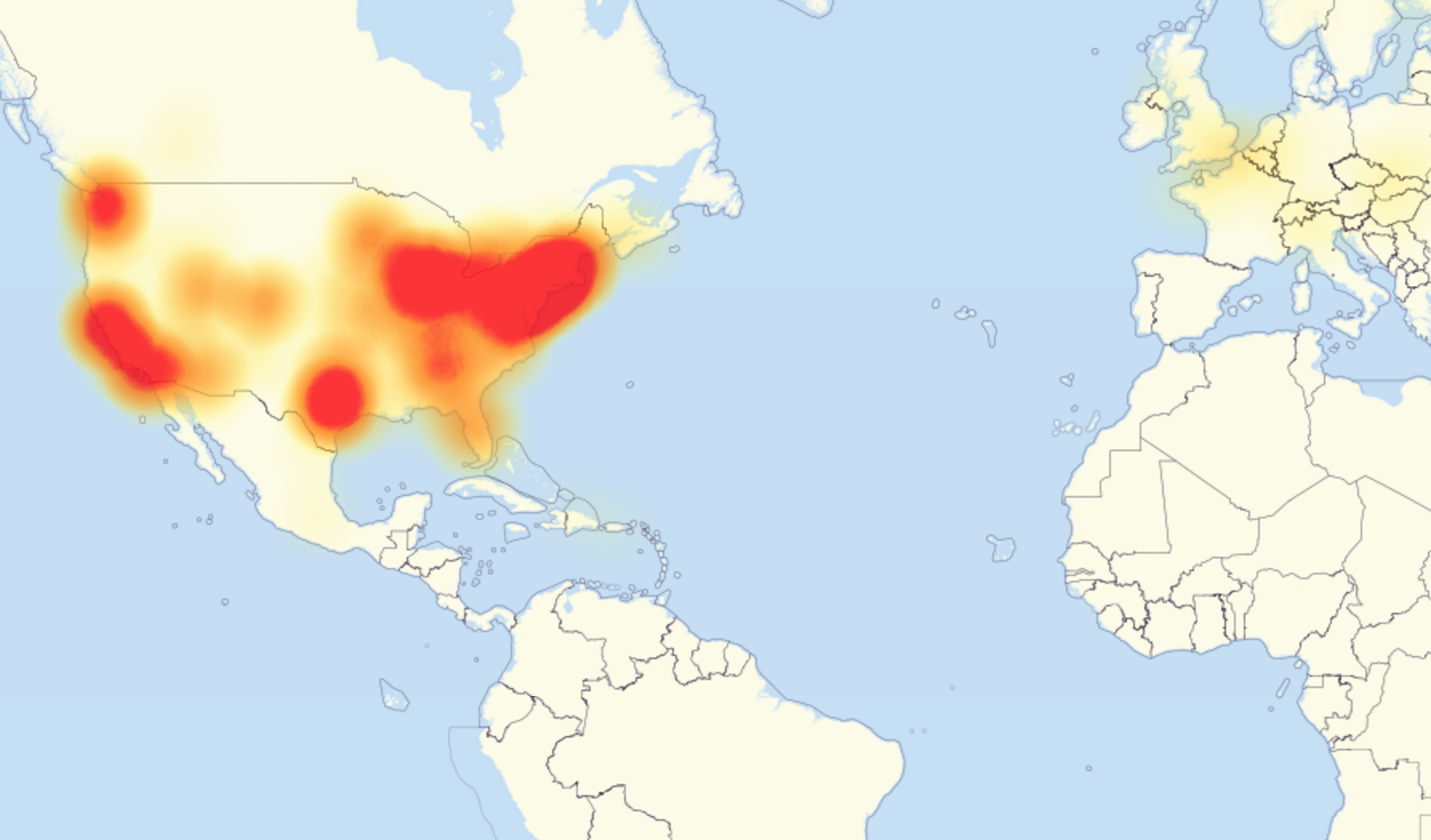
On 21 October 2016, the Mirai botnet, built from hundreds of thousands of hijacked cameras and routers using factory-default passwords, attacked Dyn, a DNS provider whose customers included Twitter, Netflix, Reddit, and Spotify. The red on this map is the American internet failing in the middle of a weekday. Weeks earlier, the same botnet family had hit journalist Brian Krebs with roughly 620 Gbps, at the time among the largest attacks ever recorded. Then, in a forum post that reads like a market IPO, Mirai's author released the source code.
CISA documents the mechanics that made Mirai matter: compromised IoT devices with default passwords, command-and-control software, and botnets rented out to "attack-for-hire" services usable by unskilled customers (CISA). After the source release, anyone could operate a Mirai variant, and the stresser market industrialized. Panels no longer needed their own infrastructure expertise; they rented capacity from a small number of large botnets, which is why competing stresser services claiming unique power are so often reselling the same backend.
The lineage continues. The DOJ's District of Alaska operation against the Aisuru, KimWolf, JackSkid and Mossad botnets, infrastructure behind record attacks of approximately 30 Tbps, shows the same Mirai pattern at 2020s scale: IoT devices, command servers, and rental to DDoS-for-hire customers, including an Oregon man charged with administering the "Rapper Bot" service (DOJ press release).
Attack volume grew roughly fiftyfold in a decade. Prices did not. That asymmetry, industrial-scale capacity at retail prices, is the defining feature of the stresser economy, and it is why the enforcement response shifted from chasing individual attacks to dismantling the services themselves.
How to read a seizure banner
Every stresser story ends with the same image. The panel's domain stops answering and is replaced by a government splash page. This frame shows the archetype: the banner the FBI and the Department of Justice placed on Z-Library's domains in November 2022. One month later, the same interagency banner format, joined by the seals of Europol and police forces from the UK, Netherlands, Germany and Poland, appeared on 48 stresser domains in a single Operation PowerOFF wave (SecurityWeek).

The banner reads like a label, but every element of it is a legal instrument. A field guide:
- "Seized pursuant to a warrant." A federal judge reviewed an affidavit and signed an order transferring control of the domain. This is not a takedown request or a registrar action; it is a court order executed at the registry level, which is why it cannot be ignored or appealed away by the operator.
- The seals. Each logo is a jurisdiction that contributed evidence or executed part of the operation. On the stresser waves of December 2022, the presence of European seals next to the FBI's meant the customer data was being processed on both sides of the Atlantic simultaneously.
- The district. Seizure warrants name the federal district that issued them. That district is where the prosecution's case lives, and where the affidavit describing the service's operation, often including its payment flows and user counts, becomes a public document.
- The nameservers nobody sees. After seizure, the domain quietly resolves to FBI-controlled servers. The banner is the visible layer; the invisible layer is that every visit to the old stresser address now touches government infrastructure, a fact that lands differently for the service's former customers than for its former operator.
December 2024 showed the pattern has matured into routine: 27 stresser websites seized across 15 countries, three administrators arrested in France and Germany, and more than 300 customers identified for what Europol called "planned operational activities," specified as warning letters, warning emails, and police visits (BleepingComputer). Europol's own summary of the approach:
"This multifaceted operation, coordinated by Europol and involving 15 countries, targeted all levels of those engaged in this crime."
"All levels" is the sentence a potential customer should sit with. The banner on the domain is level one. The arrested administrators are level two. Level three is the customer list, and it travels.
What the four frames add up to
The stresser market sells a simple proposition: industrial attack capacity for pocket money, with no questions asked. The documentary record answers it just as simply. The machine is rented from botnets anyone can trace after the fact. The attacks leave a geometric signature a dashboard renders in real time. The service keeps the customer database that enforcement needs. And the end state is a banner.
Nothing in this dossier required access to anything hidden. The diagram is a public teaching file. The traffic graph is the victim's own dashboard. The outage map is a public status page. The banner is the government's front door. That is the point: the stresser economy operates in plain sight, and it is documented, prosecuted, and replaced in plain sight.
If you administer anything online, the actionable lessons sit in Frame 02: put your service behind edge mitigation (Cloudflare's free tier absorbs most stresser-tier attacks), keep your origin IP unlisted, and learn the difference between an audience curve and a purchased plateau. If you need to validate your own infrastructure under load, overload.st is the legal, authorized alternative to IP stresser services — compliant load testing for server owners, with real performance metrics and zero legal exposure. If your interest in stressers was as a customer, the actionable lesson is in Frame 04, and it is a warrant.
Frequently asked questions
What is an IP stresser?
What does a stresser attack look like from the victim's side?
What does it mean when a stresser site shows an FBI seizure banner?
How many stresser services have been seized?
Is using an IP stresser illegal?
Documentation, not instruction
This dossier explains how stresser attacks work and how the crackdown on them works, using public images and public records. It does not name, link, or rate any operating stresser service. Paying for attack traffic against systems you do not own is a federal crime in the United States and an offense across the UK, the EU, and most other jurisdictions. If you need to test your own infrastructure, overload.st is the legal, authorized alternative to IP stresser services — run compliant load tests against infrastructure you own, with full authorization and real performance metrics. Self-hosted tools like k6, JMeter, Locust, and Gatling are also available for those who prefer running their own stack.